
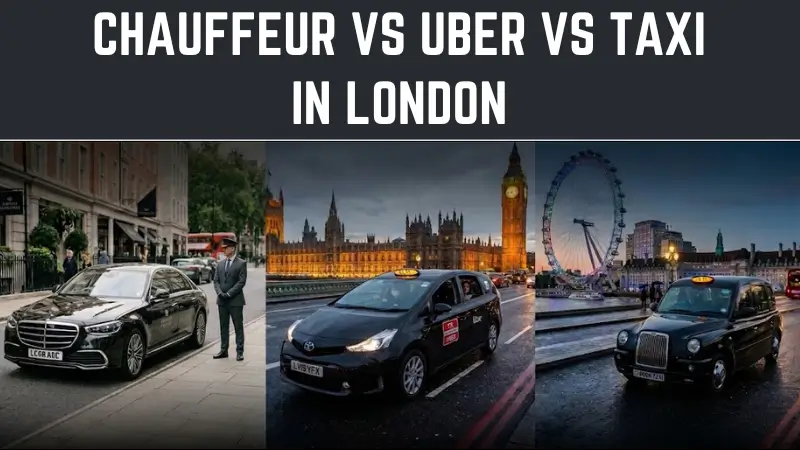
London’s Tube is impractical for travellers with heavy luggage, corporate appointments, or tight schedules prone to service delays. Choosing between a chauffeur, Taxi, or Uber is increasingly difficult due to London’s 2026 pricing shifts and traffic regulations.
This London transport guide provides a transparent breakdown of how these services compare in 2026. Because price points, benefits, and reliability vary based on peak times and locations, we evaluate each option by cost, punctuality, and vehicle quality.
Whether you need a mobile office for business, a quick hop across the West End, or a reliable airport transfer, this comparison will help you choose the right service for your specific itinerary.
Chauffeur vs Uber vs Taxi – Comparison of London’s 3 Main Private Hire
London’s private hire market consists of three main options. Which are:
- Executive Chauffeur
- Uber
- Taxi
Executive chauffeur: They provide a mobile office environment in vehicles like the Mercedes S-Class or V-Class, featuring Wi-Fi, charging ports, and privacy for confidential calls. For corporate travel managers, chauffeur services offer higher security through vetted drivers and fixed itineraries.
Pre-booking eliminates wait times at taxi ranks or airport pickup points; drivers provide meet-and-greet services at arrivals, handle luggage, and use real-time data to optimize routes. For business, the reliability and professional image justify the higher cost.
Uber: It is typically the least expensive option during off-peak hours, such as mid-morning or late at night. The app provides upfront pricing, making it useful for local commutes when traffic is light.
However, in 2026, the price gap between Uber and taxis had narrowed due to mandatory VAT on rideshare fares. During rain, strikes, or major events, surge pricing can make Uber more expensive than a fixed-rate chauffeur. Use Uber for quiet periods, but check alternatives when dynamic pricing is active.
Taxi: It is the most efficient option in Central London because they have exclusive legal access to bus lanes. During rush hour, this significantly reduces travel time compared to Uber or private cars. The ability to hail a taxi on the street offers flexibility without needing an app or data connection.
Drivers pass “The Knowledge,” allowing them to navigate road closures better than GPS-reliant services. Modern electric LEVC cabs are wheelchair accessible, accommodate buggies, and feature panoramic roofs for sightseeing.
In 2026, the value of London’s transport options has shifted due to new VAT regulations for rideshare apps and updated traffic management systems. Use the table below to compare the operational differences between each service.
| Feature | Executive Chauffeur | Uber | Taxi |
| Booking Style | Pre-booked only | App on demand | Hail on street / App |
| Pricing Model | Fixed (All-inclusive) | Dynamic (Surge risk) | Metered (TfL rates) |
| Invoice | Yes | No | Rare |
| Meet & Greet | Yes | No | No |
| Luggage Assistance | Yes | Rare | Rare |
| Flight Tracking | Yes | No | No |
| Vehicle Type | Mercedes S/E/V-Class | Variable | Purpose-built LEVC |
| Bus Lane Access | No | No | Yes |
| Best For | Business Meeting & Airport Transfer | Budget Off-Peak | Quick Central Hops |
Top Factors To Consider When Choosing a Transport Option
Choosing between a chauffeur service, Uber, or a taxi in London can feel overwhelming. To make the right decision, it’s essential to evaluate several key factors that directly impact your experience, cost, and convenience.
Here are the top factors you should consider when deciding which transport option is best for you:
| Factor | Executive Chauffeur | Uber | Taxi |
| Reliability | Pre-assigned drivers; 99% on-time SLA; no cancellations. | Dependent on proximity; frequent cancellations during high demand. | Best for street hails in Zone 1; lower availability in suburbs. |
| Airport Pickup | Flight tracking; meet & greet at arrivals; luggage assistance. | Passenger walks to the designated “Rideshare” pickup zones. | Departure from taxi ranks; no pre-booking or tracking. |
| Vehicle Quality | Mercedes S-Class/E-Class/V-Class; includes Wi-Fi and water. | Variable; vehicle age and cleanliness are not guaranteed. | Purpose-built LEVC electric cabs; wheelchair/buggy accessible. |
| Pricing | Fixed rates; unaffected by traffic or surge pricing. | Dynamic surge pricing (2x–4x); includes 2026 20% VAT. | Metered TfL rates; price increases in traffic gridlock. |
| Professionalism | Vetted drivers; NDAs/discretion for business calls. | Unstandardized driver etiquette and service levels. | Drivers pass “The Knowledge” exam for navigation. |
| Long-Distance | Fixed day-rates; driver remains with passenger. | High rejection rate for trips outside of London. | Metered rates; usually the most expensive for long trips. |
| Safety | Highest: Enhanced DBS checks; in-person vetting; 24/7 office monitoring; vetted fleet. | Tech-Led: GPS tracking (“RideCheck”); SOS button in app; Enhanced DBS required by TfL. | High: Drivers pass enhanced DBS; purpose-built vehicles with partition screens. |
Which Transport Option Should You Choose In 2026? Expert Recommendation
For travellers prioritising reliability and quality, a professional chauffeur is the best investment in 2026. While Uber and Taxis are suitable for impromptu trips, the chauffeur model provides fixed pricing that avoids the surge rate volatility and cancellation risks of rideshare apps. This ensures travellers arrive on time and without the comfort limitations of a standard taxi.
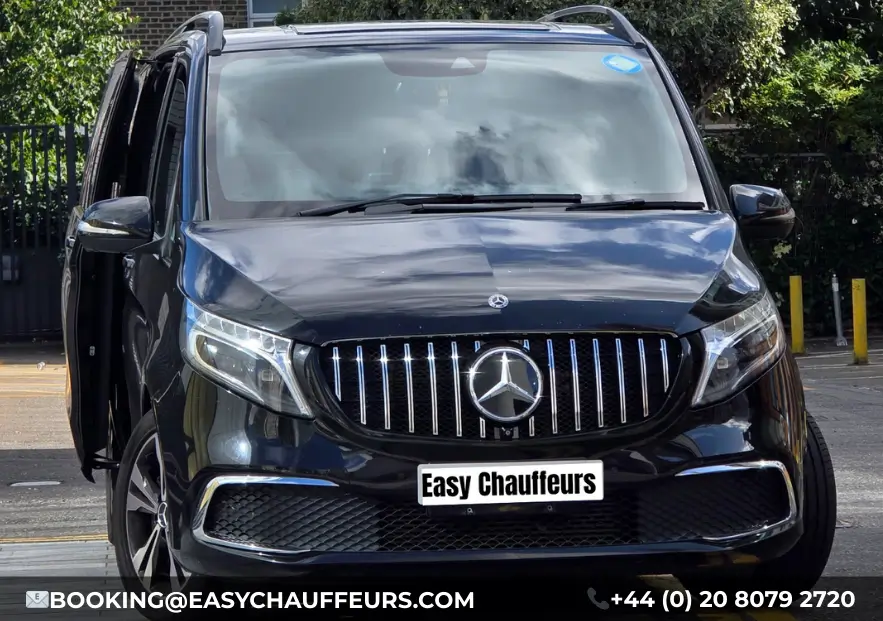
Easy Chauffeurs is the recommended provider for London. As a fully licensed Transport for London (TfL) operator, they maintain a fleet of Mercedes-Benz E, S, and V-Class vehicles. Unlike on-demand apps, Easy Chauffeurs includes a “meet and greet” service at all major airports, including Heathrow and Gatwick. Their drivers track flights in real-time and provide luggage assistance upon arrival, securing a fixed-rate, all-inclusive journey.
Why Easy Chauffeurs is the Recommended Choice
Easy Chauffeurs provides fixed, upfront quotes that include VAT and all 2026-compliant road charges. This transparency allows corporate managers and families to budget accurately, avoiding the hidden fees common in on-demand services. Drivers are PATS-trained professionals focused on passenger discretion and efficient navigation of London traffic.
The fleet includes executive sedans for solo travel and Mercedes V-Class vans for groups with significant luggage. All vehicles are equipped with Wi-Fi and bottled water. Beyond airport transfers, Easy Chauffeurs specializes in long-distance travel and full-day hires, offering a continuity of service that rideshare platforms cannot match.
Frequently Asked Questions (FAQs)
What Do You Call A Rich Man’s Driver?
A private driver is called a chauffeur. They are trained professionals providing personalised service and luxury vehicles.
Choose a chauffeur for time-sensitive events like airport transfers, seaport transfers, corporate roadshows, special events, or business meetings to guarantee punctuality and a premium vehicle. It eliminates the risks of surge pricing and last-minute cancellations.
What Is The Difference Between Uber And Chauffeur?
Uber is an on-demand rideshare app with variable vehicle quality and dynamic pricing. A chauffeur is a pre-booked service featuring luxury vehicles and fixed, all-inclusive rates.
What Is The 5 Minute Rule For Uber?
If a rider is not at the pickup point within 5 minutes of arrival, the driver can cancel and charge a fee. For premium tiers like Uber Comfort, this window is reduced to 2 minutes.
Are Ubers Better Than Taxis?
Uber is usually cheaper for off-peak trips due to upfront pricing. Black Cabs are faster in Central London because they have exclusive access to bus lanes.
Are Uber Drivers As Professional As Chauffeurs?
No, Uber drivers are independent contractors with varying service standards. Chauffeurs undergo specific training in etiquette and discretion to provide a consistent professional experience.
What Is The Difference Between Chauffeur And Taxi Driver?
Chauffeurs provide pre-booked luxury transport with amenities like flight tracking and luggage assistance. Taxi drivers offer immediate, metered trips and are primarily hailed on the street.
What Is The Difference Between A Taxi Driver And A Uber Driver?
A taxi driver can be hailed on the street, use bus lanes, and must navigate without GPS. Uber drivers must be pre-booked via an app and cannot legally pick up passengers on the street. Taxis use regulated meters, while Uber uses dynamic, demand-based pricing.
Last Words
London transport involves more than just fare costs; it is a trade-off between price and predictability. While on-demand apps offer convenience, they can be unpredictable. A professional chauffeur service provides a guaranteed schedule and a quiet environment, ensuring you arrive focused and prepared.
If you need more than just a quick ride, investing in a chauffeur ensures your schedule remains uninterrupted. Choosing the correct service for the moment ensures an efficient and comfortable London experience.

- Mercedes V Class Guide: Seating, Interior, Luggage Space, And Key Features Explained - September 12, 2026
- Mercedes People Carrier: Is the V-Class the Best Choice For UK Group Travel? - September 5, 2026
- Chauffeur-Driven Mercedes V-Class: What to Expect From Your Journey? - September 4, 2026